
To “see” it, you need to plunge down the rabbit opening of quantum mechanics - a branch of material science that portrays how light and matter carry on at nuclear scales. In this peculiar domain, matter can be in two spots without a moment’s delay; electrons can carry on as both particles and waves; and Schrödinger’s feline can be alive and dead in the meantime. On the other hand so the quantum scholars let us know.
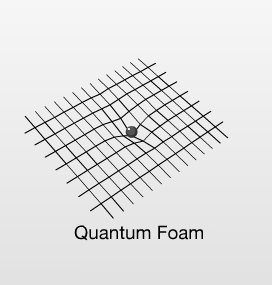
Theirs is a world uncontrollably not the same as Einstein’s. In his profoundly fruitful hypothesis of general relativity, Einstein lets us know that energy=mass and mass twists space-time. Keep in mind the material science relationship of the trampoline with a playing ball in the center? Like that ball, which tenderly contorts the trampoline’s canvas, the sun twists the smooth “canvas” of space-time enough to make planets move in bended circles. An entire system twists space-time considerably more. The more huge the body, the additionally distorting. Be that as it may, on the off chance that we could zoom in on the quantum domain, we wouldn’t see a smooth span of canvas delicately mutilated by monstrous bodies. We’d see quantum froth
Quantum gravity models foresee that space-time is a fuming froth of minor districts where minisculenew measurements spread out and after that fold back in on themselves, suddenly showing up and vanishing with incomprehensible briskness. These districts squint all through presence such as the rises in the froth of a crisply poured brew. There is no such thing as void space; there is just ‘quantum froth,’ all over the place. Such is space-time for a quantum physicist.
By Perlman of the Florida Institute of Technology, “The “rises” in the quantum froth are quadrillions of times littler than nuclear cores and keep going for tiny parts of a second—or in ‘quantum-talk’, the span of a Planck Length for a Planck Time. By scholars, this requires an extra six measurements. Space-time itself is fluctuating in these areas.”
Be that as it may, this is all noise. We can’t see this quantum froth in all its strange superbness.
Analysts need to search for confirmation of its impact to demonstrate it’s there and decide its temperament. Perlman and his partners as of late endeavored to do as such by utilizing X-beam and gamma-beam perceptions of removed quasars by the Chandra X-beam Observatory, Fermi Gamma-Ray Space Telescope, and the Very Energetic Radiation Imaging Telescope Array System, or VERITAS.
“Since these air pockets are so little and keep going for such a brief timeframe, they can never be watched specifically,” says Perlman. “Be that as it may, they would influence light in a fascinating way.”
Every photon’s way would be somewhat distinctive as it moved through the all-overrunning hordes of little variances foaming up space-time. Also, thus, the separation every photon voyages would be distinctive.
Perlman says that “Over the cosmological separations that the photons go from these removed sources, the impacts of the changes the photons experience will gather. The more they aggregate, the more out of stage the light will get. Making a picture from an accumulation of such photons would be similar to attempting to recognize what one individual is stating in a tremendous horde of individuals talking. So it would be physically difficult to get a reasonable picture.”
However, the discoveries of Perlman and his group took a touch of the bubble out of the quantum froth.
“It appears space-time must be smooth, in any event at the level of 1000x time littler than a molecule, and space-time must be a great deal less frothy than most models foresee.”
“Be that as it may, he alerts, “this examination does not go as far down as the Planck Length. So there is still some expectation for the smallest of air pockets.