
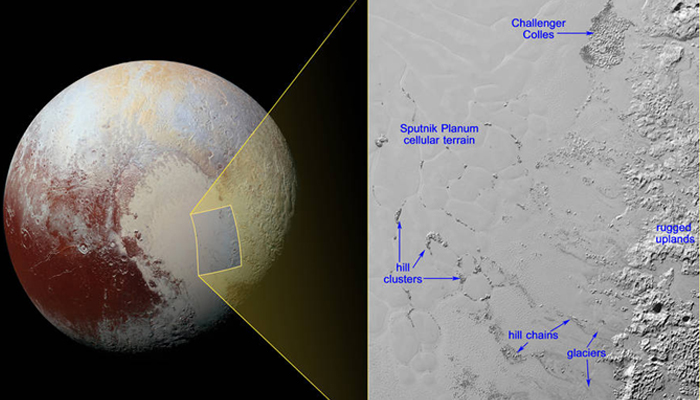
NASA’s New Horizons spots mysterious ‘floating hills’ on Pluto.
Zee Media Bureau
Washington:In a latest, the New Horizons mission scientist have revealed yet another stunning feature ‘floating hills’ of the icy planet Pluto.
According to images and data from NASA’s New Horizons spacecraft,the nitrogen ice glaciers on Pluto appear to carry an intriguing cargo:numerous.isolated hills that may be fragments of water ice from Pluto’s surrounding uplands.
Measuring about one to several miles or kilometers across, the hills, which are in the vast ice plain informally named Sputnik Planum within Pluto’s ‘heart,’ are likely miniature versions of the larger, jumbled mountains on Sputnik Planum’s western border, writes NASA on its official website.
They calls the feature as ‘yet another example of Pluto’s fascinating and abundant geological activity’.
Because water ice is less dense than nitrogen-dominated ice, scientists believe these water ice hills are floating in a sea of frozen nitrogen and move over time like icebergs in Earth’s Arctic Ocean.
They said the hills are likely fragments of the rugged uplands that have broken away and are being carried by the nitrogen glaciers into Sputnik Planum. ‘Chains’ of the drifting hills are formed along the various paths of the glaciers.
A separate collection of hills is found farther north side. The cluster is called Challenger Colle’s in honor of the crew of the lost space shuttle Challenger. The group measures 37 miles by 22 miles. Researchers think hills become “beached” in the area as they’re pushed into an especially shallow region of nitrogen ice.
At the northern end of the image, the feature informally named Challenger Colles, honoring the crew of the lost space shuttle Challenger appears to be an especially large accumulation of these hills, measuring 37 by 22 miles. This feature is located near the boundary with the uplands, away from the cellular terrain, and may represent a location where hills have been ‘beached’ due to recpect to the nitrogen ice being especially shallowed.
(Sourced By: NASA Science & Technology)